
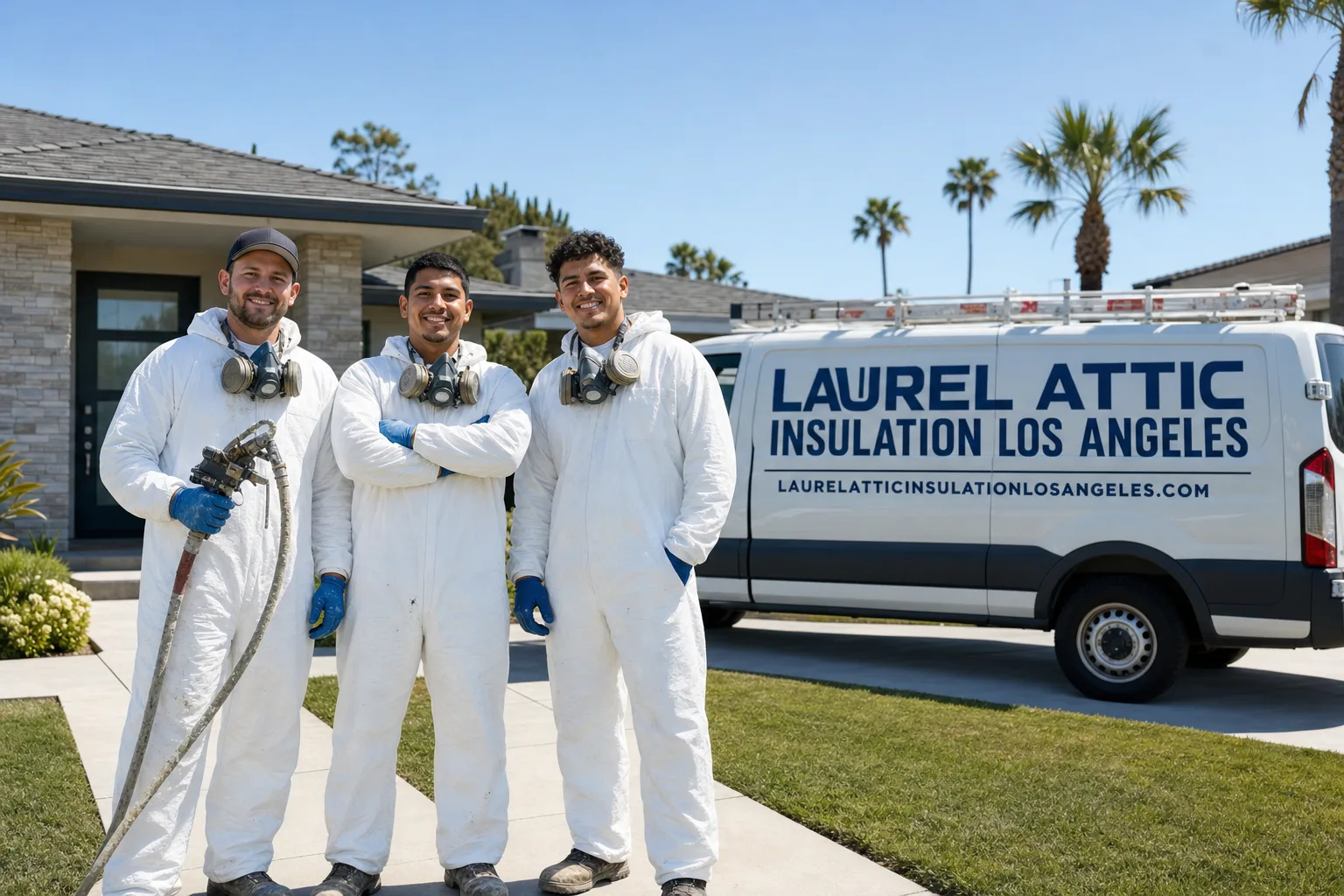
Fast, Reliable Attic Insulation Across Los Angeles
Attic insulation in Los Angeles typically costs $900 to $2,400 for a standard retrofit, with blown-in fiberglass or cellulose running $1.50 to $3.50 per square foot installed. Most Los Angeles homes we service need an R-30 to R-38 upgrade to meet today’s energy standards, especially in older houses built before Title 24 energy codes existed. We dispatch crews across Los Angeles daily, from West Adams to Woodland Hills to San Pedro, with live arrival tracking so you know exactly when we’ll pull up. Call (213) 698-7067 for a written quote before any work starts.
Why Laurel Attic Insulation Los Angeles Is Los Angeles’s Preferred Attic Insulation Company
Homeowners across Los Angeles call us because we show up with a written price, not a guess. Laurel Attic Insulation has been part of the Relay Home Co. family since 2003, and every job is bound to two non-negotiables: a written quote before anything starts, and the 365-Day Done Right Promise in writing. If it’s not right, we make it right. No argument.
Our crews know Los Angeles housing stock the way a local should. We know that a 1920s bungalow in Echo Park has a completely different attic than a 1960s tract home in Reseda. That matters when you’re deciding between blown-in insulation and batts. Our technicians are background-checked and uniformed, and they arrive at a live, trackable time, not a four-hour window. When Los Angeles homeowners call (213) 698-7067, a real person answers. 24/7. No voicemail, no callback queue.
Chase Whitaker, who leads Laurel Attic Insulation Los Angeles, puts it simply: the Relay Visibility Guarantee means you get before-and-after photos, live arrival tracking, and a written price on every single job. That’s the standard. If you want Attic Insulation done with proof at every step, we’re the crew for it.
Attic Mold Removal in Los Angeles
Attic mold removal in Los Angeles is something we handle more often than homeowners expect, particularly within a few miles of the coast where the marine layer pushes damp air into vented attics every night. Kraft-faced batts installed upside down trap that moisture against the roof deck, and within a year or two you get mold colonies under the insulation. In Los Angeles this typically runs $800 to $2,000 depending on attic size and how far the mold has spread. Call (213) 698-7067 for a written estimate.
Marine Layer Moisture and Mold
Homes in Los Angeles neighborhoods like Venice, Playa del Rey, and San Pedro get nightly fog from May through July. That fog doesn’t stay outside. It moves through attic vents and condenses on cool roof sheathing. If the insulation was installed incorrectly, especially kraft-faced batts with the paper facing the wrong direction, that moisture stays trapped against the wood and mold takes hold. We find it under the batts, not on top, because the paper acts like a barrier that holds water in place.
Removal and Air Sealing
We remove contaminated insulation, treat the affected roof deck, and address the ventilation problem that caused it. Simply pulling moldy batts and blowing in new insulation without fixing attic airflow just means you’ll call us again in two years. In Los Angeles, proper baffle installation at the eaves and balanced ridge or roof vents matter because the marine layer is predictable. It comes back every summer. Your attic either handles it or it doesn’t.
Attic Insulation Removal in Los Angeles
Attic insulation removal in Los Angeles typically runs $1 to $2.50 per square foot, so a 1,200-square-foot attic often lands between $1,200 and $3,000 depending on access, material type, and whether we’re dealing with rodent contamination or old asbestos-vermiculite. Los Angeles homeowners call us for removal when insulation has settled, been soaked by a roof leak, or is saturated with decades of dust and pest waste. Call (213) 698-7067 to schedule removal and replacement with a written price upfront.
When Removal Becomes Necessary
In Los Angeles, blown-in fiberglass settles unevenly in shallow-pitch attics, and within ten to fifteen years you get bare patches over ceiling light fixtures and around access hatches. Those bare spots are heat leaks. We also see Rockwool batts from the 1940s and 50s that have compressed to half their original thickness. At that point, topping up isn’t the right call. It’s removal and a clean start.
Removal Before Reinsulation
Our crew worked on a 1923 Craftsman bungalow in West Adams where the attic had settled Rockwool batts pressed against corroded galvanized wire supports. We pulled the old batts, replaced rusted vents with stainless models, and blew in Owens Corning ProPink to R-38. The homeowner immediately felt the difference during the August heat wave. If you’ve got an older Los Angeles home with original insulation, removal is often the only way to get a true R-value.
Trusted Brands We Service in Los Angeles
We install and service insulation from the brands Los Angeles homeowners actually ask for: Owens Corning, GreenFiber, and Johns Manville. Every material gets matched to the job, not to whatever happens to be on the truck. For tall attics with open framing, blown-in GreenFiber cellulose gets into corners and around old wiring better than batts. For tight spaces and cathedral ceilings, Owens Corning batts with the right R-value do the job. We keep a range of materials stocked for Los Angeles jobs, and our suppliers include Knauf when the project calls for it. Fast turnaround isn’t a slogan. It’s how we schedule.
Common Attic Insulation Problems We See in Los Angeles Homes
- Corroded attic vents and fasteners from salt air: Homes within three miles of the Pacific, from Pacific Palisades down to Long Beach, deal with rust on attic vent screens, fasteners, and wire supports. When vents corrode, they let embers into the attic during wildfire season. We replace rusted hardware with stainless or coated alternatives as part of a full attic insulation job.
- Foil-backed kraft paper that fails in Valley heat: San Fernando Valley tract homes built in the 1950s and 60s often have foil-backed kraft paper stapled directly to the studs. On a 100°F day the attic hits 140°F and that material does almost nothing. We see collapsed batts and zero attic ventilation in Encino, Reseda, and Northridge all summer long.
- Moisture trapped beneath kraft-faced batts: Coastal fog and the marine layer push damp air into attics from Santa Monica to San Pedro. When kraft-faced batts are installed with the paper facing the living space, that moisture gets trapped above the paper and under the insulation. The result is mold, rusted nails, and rotting roof decking.
- Settled blown-in fiberglass over light fixtures: In older Los Angeles homes with shallow-pitch roofs, blown-in insulation settles unevenly. We routinely find bare spots directly above ceiling light fixtures in homes built before 1980. Those bare patches are heat leaks that drive up cooling costs from June through September.
Pricing for Attic Insulation in Los Angeles, CA
We Also Serve Cities Near Los Angeles
If you’re just outside city limits, we cover that too. Our Los Angeles crews regularly handle Attic Insulation in Los Angeles and the surrounding communities. We run jobs in Huntington Park, Lynwood, Lawndale, and Culver City, with the same written pricing and live arrival tracking we offer across Los Angeles proper. If you’re in any of these cities, call (213) 698-7067 and we’ll schedule you the same way.
Serving Los Angeles, CA - Our Local Coverage Area
We’re based in the Los Angeles area and know this community well. Use the map below to see our service coverage - if you’re nearby, we can almost certainly help.
FAQs About Attic Insulation in Los Angeles
How does salt air from the Pacific actually damage attic insulation in Los Angeles homes?
Salt-laden air corrodes metal attic vent screens, fasteners, and wire supports within three miles of the coast, and once those fail, moisture and embers get into the attic. Corroded vents let embers in during wildfire season, and rusted fasteners eventually drop insulation onto the ceiling below. In Los Angeles neighborhoods like Venice, Mar Vista, and San Pedro, we recommend stainless or coated hardware whenever we do an insulation job. Call (213) 698-7067 for a free inspection and written quote.
What’s the most common attic insulation failure in San Fernando Valley tract homes?
Foil-backed kraft paper stapled to studs, and it fails to stop radiant heat. On a 100°F day in Encino or Woodland Hills, attics hit 140°F and the original batts have usually collapsed. We pull that old material and blow in Owens Corning or GreenFiber to R-38, and the difference in ceiling temperature is noticeable within a day. Written pricing before we start. Always.
Can improper attic insulation cause mold in Los Angeles despite the dry climate?
Yes. The marine layer is the culprit, not rain. Coastal fog moves into attics every summer night from Santa Monica to Long Beach, and kraft-faced batts installed upside down trap that moisture against the roof deck. Mold grows under the insulation, hidden until we lift a batt. Los Angeles homeowners within a few miles of the ocean should have attic ventilation checked at least once every couple of years. Call (213) 698-7067 if you haven’t looked in a while.
Why do attic insulators in Los Angeles need to consider wildfire ember intrusion?
Because embers enter attics through corroded or damaged attic vents, and once inside they ignite insulation within minutes. Hillside communities from Bel Air to Mount Washington to the Hollywood Hills face this risk every fire season. Attic insulation crews in Los Angeles should inspect vent screens and install or recommend ember-resistant venting. We check every vent as part of the job, not as an upsell.
Is blown-in or batt insulation better for older LA homes with plaster walls and limited attic access?
Blown-in is almost always the better call. Older Los Angeles homes, especially 1920s Craftsman bungalows and Spanish Colonial Revivals in West Adams, Highland Park, and Boyle Heights, often have tight attics and plaster walls that make batt installation impractical. Blown-in GreenFiber or Owens Corning fiberglass fills irregular cavities and old wiring gaps without tearing out walls. We’ll give you a written recommendation and price before anything starts. Call (213) 698-7067.
Written by Chase Whitaker, Owner at Laurel Attic Insulation Los Angeles, serving Los Angeles since 2003 as part of the Relay Home Co. family.